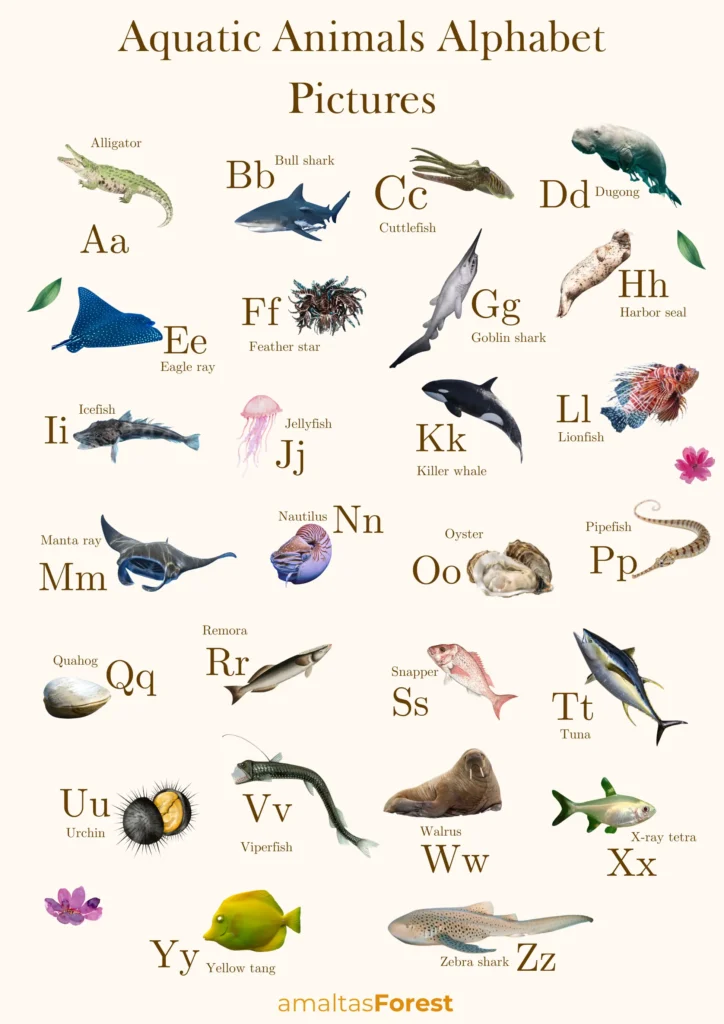
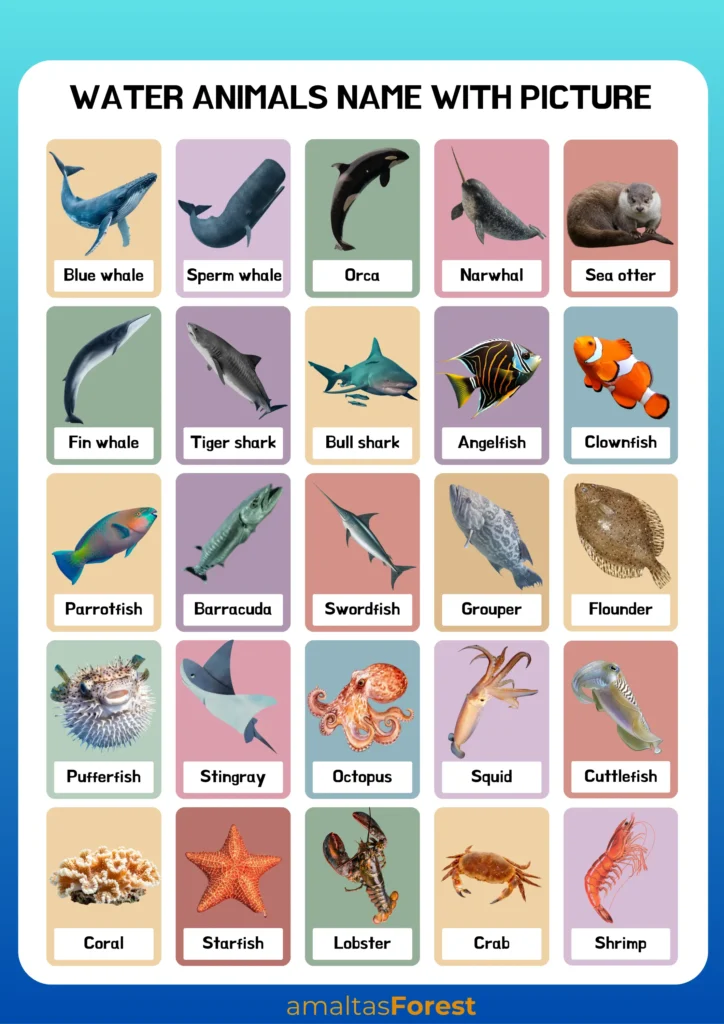
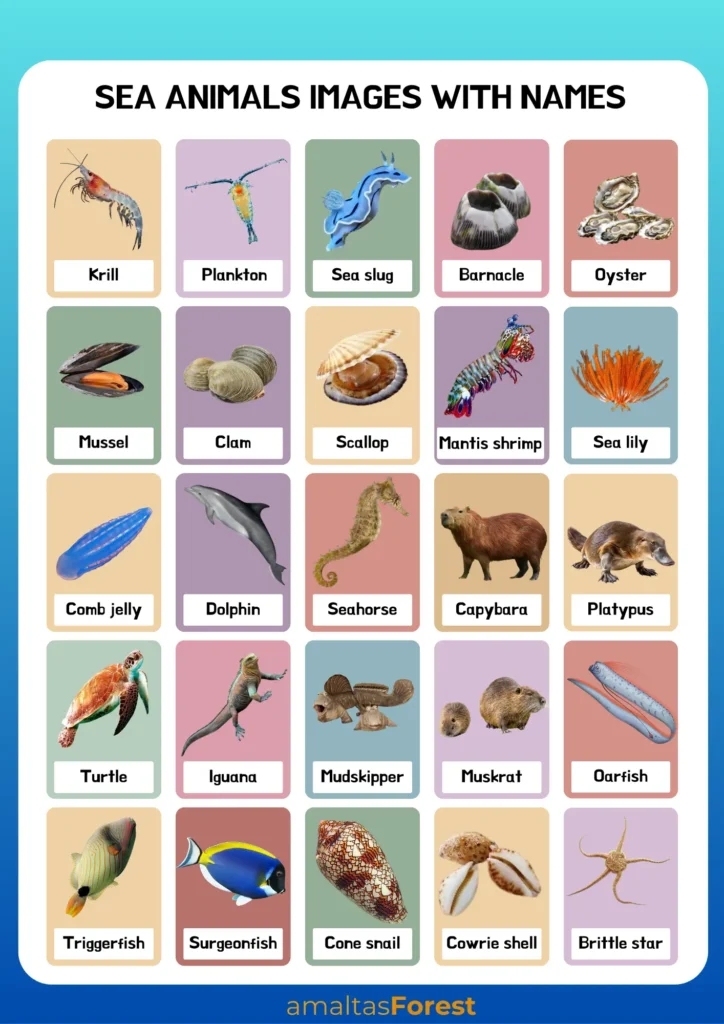
Hey ! little learners have you ever wondered what kind of water animals live inside water ? like starfish, seahorse, whale, dolphin etc.. their key features, food cycle, and their characteristics.
Let’s learn together water animals names in English , with beautiful sea animals images, sea creatures facts with printable worksheets for practice. Help primary and kindergarten children to build vocabulary and wisdom.
What are the different types and main adaptations of aquatic animals ?
Aquatic animals are animals that live in water. They come in many types, like fish, whales, crabs, and jellyfish. Some live in rivers and lakes, some in the ocean, and some can live in both. Each one has special body features that help it swim, breathe, and survive in water.
Different Types of Aquatic Animals :
- Fish (Pisces) : Largest group with gills, scales, and fins, includes sharks, tuna, goldfish and salmon.
- Mammals : Warm-blooded air-breathers like whales, dolphins, seals, sea otters and manatees.
- Reptiles : Semi-aquatic swimmers such as crocodiles, sea turtles, sea snakes and water monitor lizards.
- Amphibians : Water-dependent early life stages, like frogs in ponds.
- Birds : Waterbirds including penguins that swim extensively.
- Invertebrates : Backbone-less groups like mollusks (octopus, squid), crustaceans (crabs, shrimp), echinoderms (starfish), cnidarians (jellyfish), and plankton.
- Mollusks : They have soft bodies, and some have shells. They can release ink and use camouflage to hide from predators. Example : Octopus, Squid, Clam, Nautilus.
- Crustaceans : They have a hard outer shell called an exoskeleton, jointed legs, and strong claws for defense. As they grow, they shed their shell in a process called molting. Example : Crabs, Lobsters, Shrimp, Barnacles.
Key Adaptations :
- These features help aquatic animals float, handle water pressure, breathe with less oxygen, and stay safe from predators.
- Their smooth, streamlined bodies and fins or flippers help them swim easily. Tail fins push them forward, side fins help them steer, and top fins keep them balanced.
- Fish use gills to breathe oxygen from water. Marine mammals breathe through blowholes, stay warm with a thick layer of blubber, and can dive for a long time because their muscles store extra oxygen.
- Other special features include swim bladders that help bony fish float, side lines that help sharks sense movement in water, camouflage to help flat rays blend in, and small breathing holes called spiracles for animals that live on the ocean floor.
Aquatic Animals Characters :
Aquatic animals have special features that help them live in water, like smooth bodies and different ways to breathe. These help them survive in oceans, rivers, and ponds. 🌊🐟
- Body Structure : Water animals have streamlined bodies to reduce water resistance for efficient swimming, torpedo-shaped with pointed ends and wider middles. Fins, flippers or tails provide propulsion, steering and stability, caudal fins push forward, pectoral fins balance.
- Respiration : Most aquatic animals use gills to breathe oxygen from water. Dolphins and other aquatic mammals breathe air with lungs and blowholes, so they come up to the surface. Some amphibians can even breathe through their skin while in water.
- Buoyancy Control : Bony fish use swim bladders filled with gas to help them float or change depth without sinking. Sharks float using oily livers, and penguins have heavy bones that help them dive deep.
- Sensory Adaptations : Some aquatic animals use lateral lines to feel vibrations and water movement. Dolphins and whales use echolocation, sending out sounds to find their way in dark water. Others can glow in the deep ocean to talk to each other or catch food.
- Lifestyle Traits : Some aquatic animals swim actively, like fish and squid. Others drift with the water, and some crawl along the bottom, like crabs and starfish. Mammals are warm-blooded and feed milk to their babies, while most fish are cold-blooded and lay eggs.
Also check out list of animals that are omnivores with printable worksheets for improving animal awareness.
Sea Creatures for Kindergarten
Kindergarten kids love bright, friendly sea animals that make them curious about the ocean. Easy names and fun facts help make learning exciting and fun.
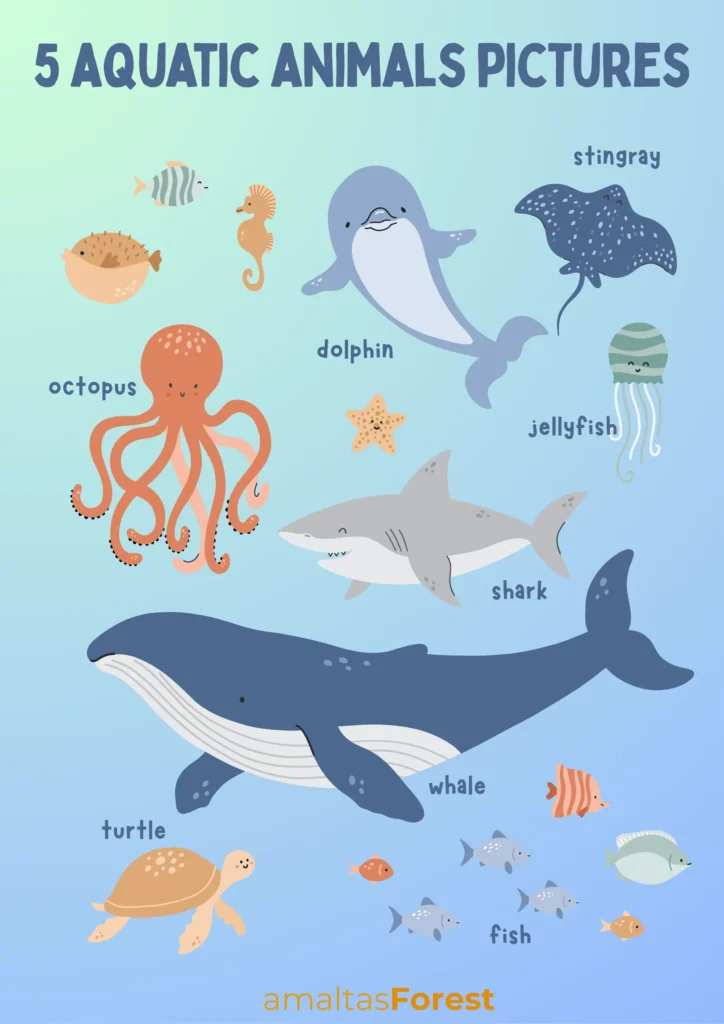
- Dolphin: A happy swimmer that loves to jump and make clicking sounds.
- Shark: A big, strong fish with sharp teeth, some like whale sharks are gentle and friendly.
- Octopus: Has eight arms and squirts ink to hide.
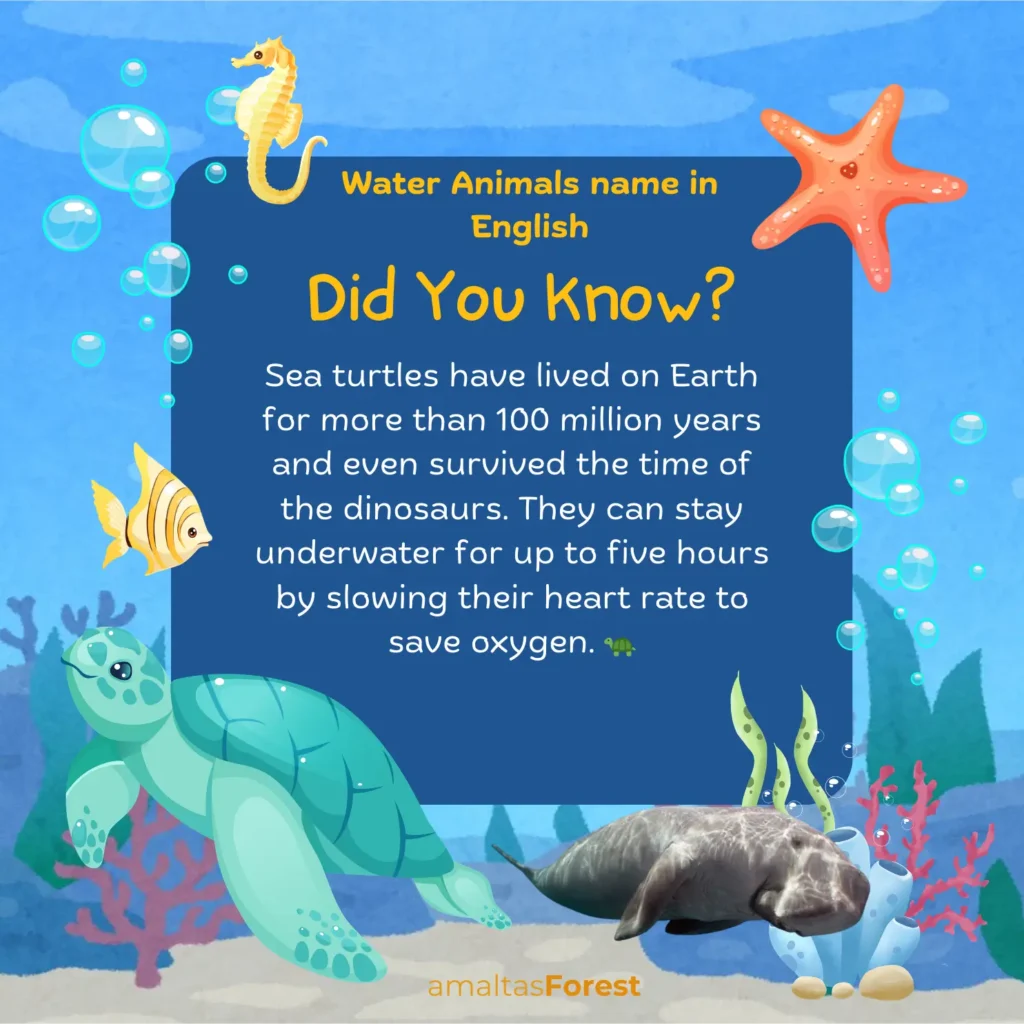
- Sea Turtle: Swims long distances and lays eggs on sandy beaches.
- Jellyfish: Floats softly with wiggly, squishy tentacles.
- Starfish: Has spiky arms and lives on the ocean floor.
- Seahorse: Small and cute, swims upright like a tiny horse.
- Crab: Walks sideways and has pinchy claws.
- Whale: A giant ocean friend that sings and blows water in the air.
- Clownfish: Bright and colorful, loves hiding in sea anemones.
Check out this Carnivorous Animals Colouring Worksheet featuring animals like the Lion and Tiger, great for boosting kids’ motor skills while learning.
Small Aquatic Animals
Small water animals include tiny fish, little sea creatures, and plankton that live in oceans, rivers, and ponds. They stay safe by camouflage, moving quickly, or sticking together in groups.
1. Tiny Fish
These are very small swimmers, usually shorter than a finger, and are often found in coral reefs or aquariums.
- Pygmy seahorse: Super tiny (1-2 cm) and hides by matching the color of corals.
- Baby clownfish: About 3-5 cm long and likes to live safely in sea anemones.
- Goby: Very small (1-5 cm) and loves hiding in sand or little holes.
- Pinkeye goby: Around 2.5 cm, almost see-through, with cute pink eyes.
2. Invertebrates
These are tiny or small ocean creatures without backbones, and there are lots of them in the sea.
- Zooplankton: Super tiny (smaller than a grain of rice) and float in water; many fish eat them.
- Sexy shrimp: About 1 cm long and looks like it’s dancing on corals.
- Skeleton shrimp: Less than 2 cm and clings to seaweed with its skinny body.
- Nudibranch: Small (2-5 cm), colorful sea slugs that look like living rainbows.
3. Plankton and More
Plankton are tiny living things that start the ocean food chain.
- Phytoplankton: Super tiny plants that make food using sunlight.
- Rotifers: Microscopic animals that look like they have spinning wheels.
- Dwarf lanternshark: A very small young shark, about 20 cm long.
These little creatures help feed bigger animals and show if the water is healthy.
10 Water Animals Name
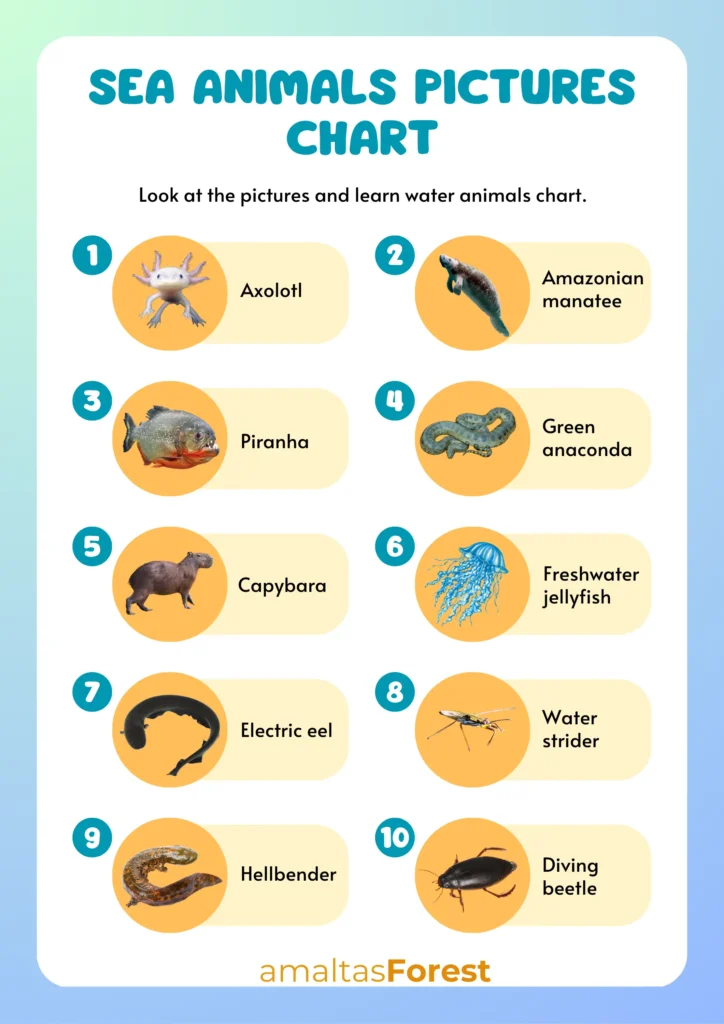
Below is the list of 10 water animals named live in freshwater and marine animals suitable for educational use.
- Axolotl: A cute salamander that can regrow lost body parts.
- Piranha: A small fish from South America with very sharp teeth.
- Capybara: The biggest rodent in the world that loves water.
- Electric eel: A long fish that makes electric shocks to catch food.
- Hellbender: A big river salamander that hides under rocks.
- Amazonian manatee: A gentle, plant-eating water giant.
- Green anaconda: A huge snake that lives in swamps and rivers.
- Freshwater jellyfish: Tiny jellyfish that float and gently sting.
- Water strider: An insect that can walk on top of water.
- Diving beetle: A beetle that swims underwater using air bubbles.
Do read carnivore animals name lists animal chart help kids to learn animal food habit and living habitat.
Sea Animals Facts
Sea animals have amazing features that kids love, like very big sharks, whales etc.. or using smart tricks to stay safe. These fun facts help children learn more about different sea animals, tiny creatures and their names.
- Size Wonders : Blue whales are the biggest animals on Earth, longer than three school buses and heavier than 30 elephants! Whale sharks are the largest fish, with pretty polka-dot spots, and they gently eat tiny plankton.
- Clever Behaviors : Octopuses can change color to hide, squirt ink to escape, and squeeze through very small spaces with their three hearts. Dolphins jump out of the water, use clicking sounds to “see,” and even hold fins while sleeping together.
- Long Journeys : Sea turtles swim thousands of miles and use Earth’s magnetic clues to find the same beaches where they were born to lay eggs. Salmon travel from the ocean back to rivers, even jumping over waterfalls, to lay their eggs.
- Unique Swimmers : Penguins flap their flippers to “fly” through the water and cuddle together to stay warm. Seahorses swim standing up, and the dads carry the babies in special pouches. Manta rays glide gracefully like birds underwater with their big, wing-like fins.
20 water animals name
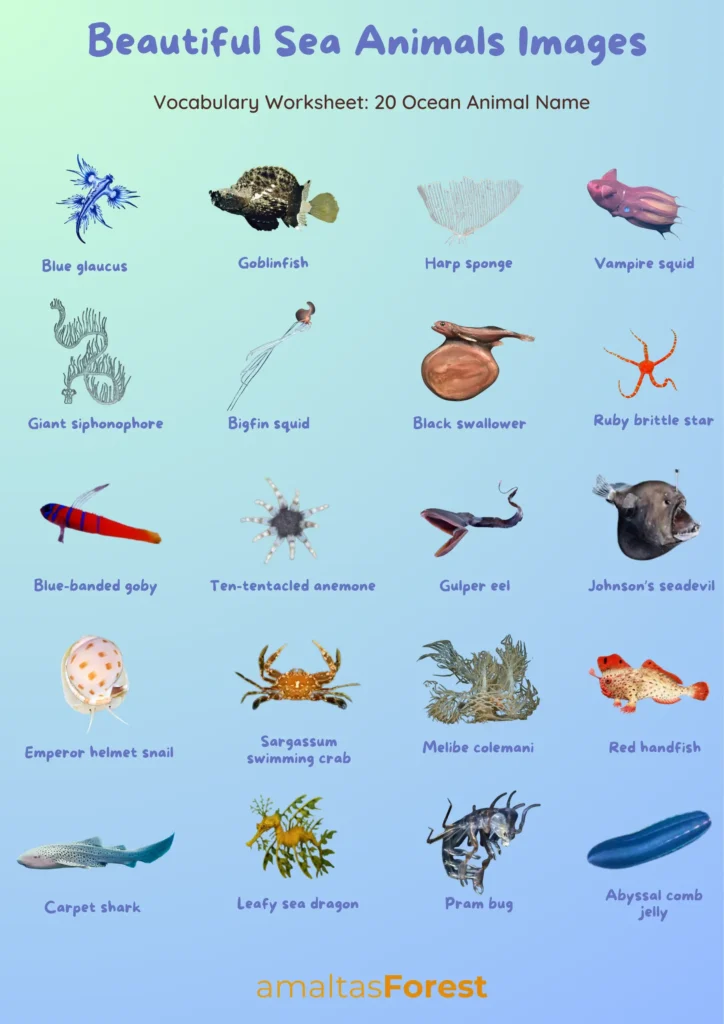
Here are 20 new and unique animal names, tiny creatures, kids favorites or freshwater animals.
| 1. Blue glaucus | 11. Gulper eel |
| 2. Goblinfish | 12. Johnson’s seadevil |
| 3. Harp sponge | 13. Emperor helmet snail |
| 4. Vampire squid | 14. Sargassum swimming crab |
| 5. Giant siphonophore | 15. Melibe colemani |
| 6. Bigfin squid | 16. Red handfish |
| 7. Black swallower | 17. Carpet shark |
| 8. Ruby brittle star | 18. Leafy sea dragon |
| 9. Blue-banded goby | 19. Pram bug |
| 10. Ten-tentacled anemone | 20. Abyssal comb jelly |
To make the learning more informative check out herbivorous animals names meaning and pictures with activities worksheets.
Ocean Plants List
Ocean plants mostly contain seagrass, algae and coral, they are vital parts of underwater ecosystems that oxygenate water and feed on marine life. The plants mostly thrive in sunlight zones.
- Phytoplankton: Tiny, single-celled organisms that float in the water, such as diatoms and coccolithophores. They are very important because they produce about half of the Earth’s oxygen.
- Seagrasses: Flowering underwater plants like eelgrass. They grow in large meadows that provide shelter for fish and help store carbon in the ocean.
- Kelp: Giant brown algae that form underwater forests. Some kelp can grow up to 45 meters tall.
- Red Algae (Rhodophyta): Branching or leaf-like seaweeds that can grow in deeper waters. Their red pigments help them absorb light in low-light conditions.
- Green Algae (Chlorophyta): Includes sea lettuce (Ulva). These are simple, sheet-like or thread-like plants commonly found near shorelines.
- Brown Algae (Phaeophyta): Includes Sargassum, which forms floating mats, as well as rockweed and kelp that attach to rocks.
- Coralline Algae: Hard, calcified algae that help build and strengthen coral reefs, often appearing in pink or red colors.
- Halimeda: A type of calcified green algae with segmented structures that plays an important role in building tropical reef systems.
50 Water Animals Name
Below is the list of diverse species of water animals selection across fish, mammals, aquatic reptiles and invertebrates help children to widen their vocabulary knowledge.| Ocean Mammals | Reptiles & Invertebrates |
| 1. Beluga whale | 26. Leatherback turtle |
| 2. Narwhal | 27. Green sea turtle |
| 3. Orca (killer whale) | 28. Hawksbill turtle |
| 4. Sperm whale | 29. Olive ridley turtle |
| 5. Humpback whale | 30. Nautilus |
| 6. Gray whale | 31. Lobster |
| 7. Minke whale | 32. Horseshoe crab |
| 8. Pygmy sperm whale | 33. Sea urchin |
| 9. Harbor porpoise | 34. Sea cucumber |
| 10. Dall’s porpoise | 35. Barnacle |
| Fish Varieties | More Marine Life |
| 11. Barracuda | 36. Cleaner shrimp |
| 12. Moray eel | 37. Pistol shrimp |
| 13. Lionfish | 38.Cone snail |
| 14. Parrotfish | 39. Cowrie shell |
| 15. Remora | 40. Abalone |
| 16. Manta ray | 41. Sea anemone |
| 17. Stingray | 42. Feather duster worm |
| 18. Hammerhead shark | 43. Christmas tree worm |
| 19. Lemon shark | 44. Brittle star |
| 20. Nurse shark | 45. Basket star |
| 21. Angelfish | 46. Sea lily |
| 22. Butterflyfish | 47. Nudibranch |
| 23. Surgeonfish | 48. Comb jelly |
| 24. Triggerfish | 49. Salp |
| 25. Pufferfish | 50. Portuguese man o’ war |
Large Aquatic Animals
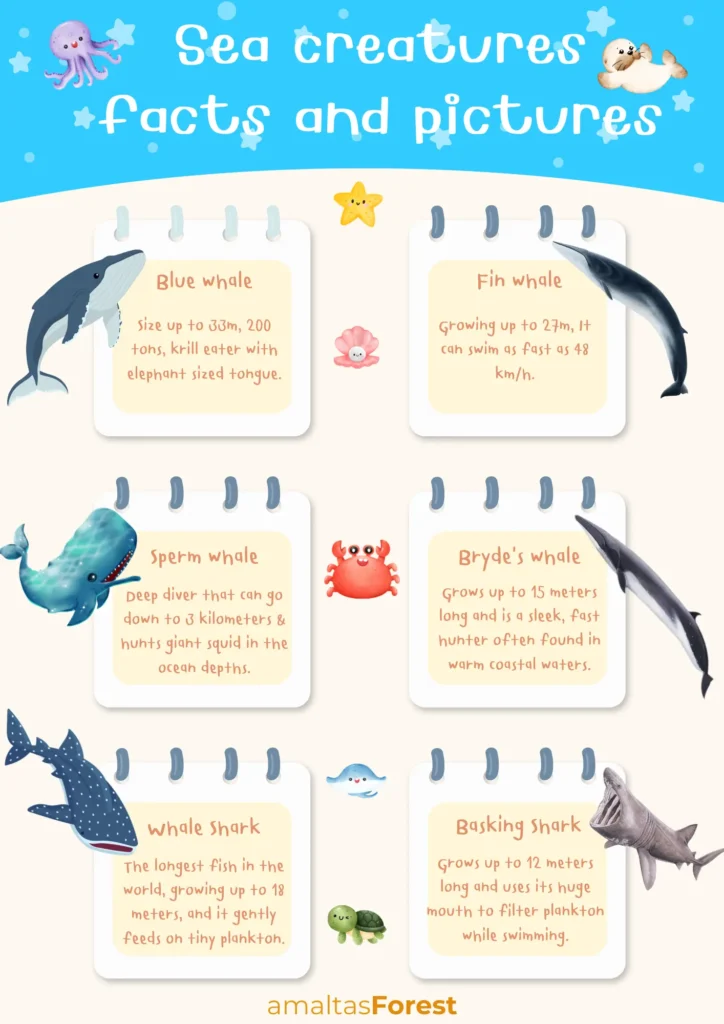
Large aquatic animals rule oceans and large water bodies, often exceeding 10 meters in length or hundreds of tons in weight.
Largest by Length
- Blue whale: Size up to 33m, 200 tons, krill-eater with elephant-sized tongue.
- Fin whale: Second longest at 27m, speeds to 48 km/h.
- Sperm whale: Deep divers to 3km, hunt giant squid.
- Bryde’s whale: 15m, sleek coastal hunters.
Giant Fish
Some of the largest fish in the ocean, some are gentle filter feeders, while others are powerful predators. A few fish have soft skeletons made of cartilage instead of hard bones.
- Whale Shark: The longest fish in the world, growing up to 18 meters, it is very gentle and feeds mainly on tiny plankton.
- Basking Shark: Grow up to 12 meters long. It has a very large mouth that filters plankton from the water as it swims.
- Giant Oceanic Manta Ray: Has an impressive wingspan of up to 9 meters. It performs graceful somersaults while feeding on plankton.
- Oarfish: A long, slender fish that can grow up to 11 meters. Because of its ribbon-like body, it is also called the “sea serpent.”
Other Ocean Megafauna
The ocean is also home to other giant creatures. Some are reptiles, and some are massive squid. These animals add to the amazing size and diversity of ocean life.
- Giant Squid: Can grow up to 14 meters long, including its long tentacles. It is one of the largest squid species and a famous deep-sea giant.
- Leatherback Sea Turtle: The largest sea turtle in the world. It can grow up to 2.7 meters long and weigh around 900 kilograms. It can dive as deep as 1 kilometer underwater.
- Colossal Squid: Can grow over 10 meters long and is considered the heaviest invertebrate on Earth.
- Saltwater Crocodile: Can reach up to 7 meters in length. It lives in coastal waters and river mouths and is one of the largest living reptiles.
Learn pet animals name in hindi and english and helps to understand pets as a companion .
Water Animals Name in Hindi and English
20 water animals named in Hindi are listed below to help kids in developing bilingual vocabulary.
| English | Hindi |
| 1. Dolphin | डाल्फिन मछली |
| 2. Shark | शार्क मछली |
| 3. Octopus | ऑक्टोपस |
| 4. Whale | ह्वेल मछली |
| 5. Turtle | समुद्री कछुआ |
| 6. Crab | केकड़ा |
| 7. Lobster | झींगा मछली |
| 8. Jellyfish | जेलीफिश |
| 9. Seahorse | समुद्री घोड़ा |
| 10. Starfish | स्टारफिश |
| 11. Penguin | पेंगुइन |
| 12. Squid | विद्रूप |
| 13. Seal | सील |
| 14. Sea Lion | जल सिंह |
| 15. Shrimp | झींगा |
| 16. Clam | क्लैम |
| 17. Coral | प्रवाल |
| 18. Sea Urchin | समुद्री साही |
| 19. Walrus | वालरस |
| 20. Pelican | हवासील |
Animals Live in Water and Land
Nature has a lot of wonders hidden in their environments, there are semi-aquatic animals that live in both water and land, often hunting, breeding or escaping predators across habitats like rivers, swamps, and shores.
- Capybara: The largest rodent in the world. It eats aquatic plants and can hold its breath underwater for up to 5 minutes.
- Otter: A sleek and playful hunter with webbed paws. It lives in dens along riverbanks.
- Beaver: Famous for building dams. It uses its strong, paddle-shaped tail to help it swim.
- Platypus: A unique egg-laying mammal. It uses electroreception to detect prey in streams.
- Hippopotamus: Large river animals whose skin releases a special red liquid that acts like natural sunscreen.
- Crocodile: A powerful ambush predator that can stay underwater for long periods using its strong lungs. It builds nests along riverbanks and shores.
- Frog: Its babies called tadpoles live fully in water. Adult frogs can hop between ponds and land.
- Water Snake: An excellent swimmer that lives near water. It lays eggs or gives birth to live young on riverbanks.
- Marine Iguana: Dives into the ocean to eat algae and sneezes out extra salt. It is found on the Galápagos Islands.
- Turtle: Has a strong shell for protection on land and uses its flippers or legs to swim in rivers and lakes.
- Penguin: Uses its flippers to “fly” underwater and breeds on cold, icy shores.
- Water Buffalo: Loves to cool off by wallowing in mud and grazes in fields near ponds and rivers.
- Mudskipper: A unique fish that can walk on land using its strong pectoral fins.
- Muskrat: A small rodent that builds lodges in wetlands, and its long tail helps it swim.
Water animals names in Marathi
| English | Marathi |
| 1. Shark | शार्क मासा |
| 2. Crab | खेकडा |
| 3. Fish | मासा |
| 4. Frog | भेकडूक |
| 5. Octopus | अष्टबाहू |
| 6. Turtle | समुद्र कासव |
| 7. Lobster | चिंगामासा |
| 8. Dolphin | डॉल्फिन मासा |
| 9. Seahorse | समुद्री घोड़ा |
| 10. Starfish | तारामासा |
| 11. Jellyfish | जेलिफिश |
| 12. Squid | माकुल मासा |
| 13. Prawn | कोळंबी |
| 14. Sea Urchin | समुद्री साही |
| 15. Seal | मुहर मासा |
| 16. Penguin | पेंग्विन |
| 17. Crocodile | मगर |
| 18. Clownfish | जोकर मासा |
| 19. Ray | किरण मासा |
| 20. Whale | व्हेल मासा |
100 Sea Animals pdf
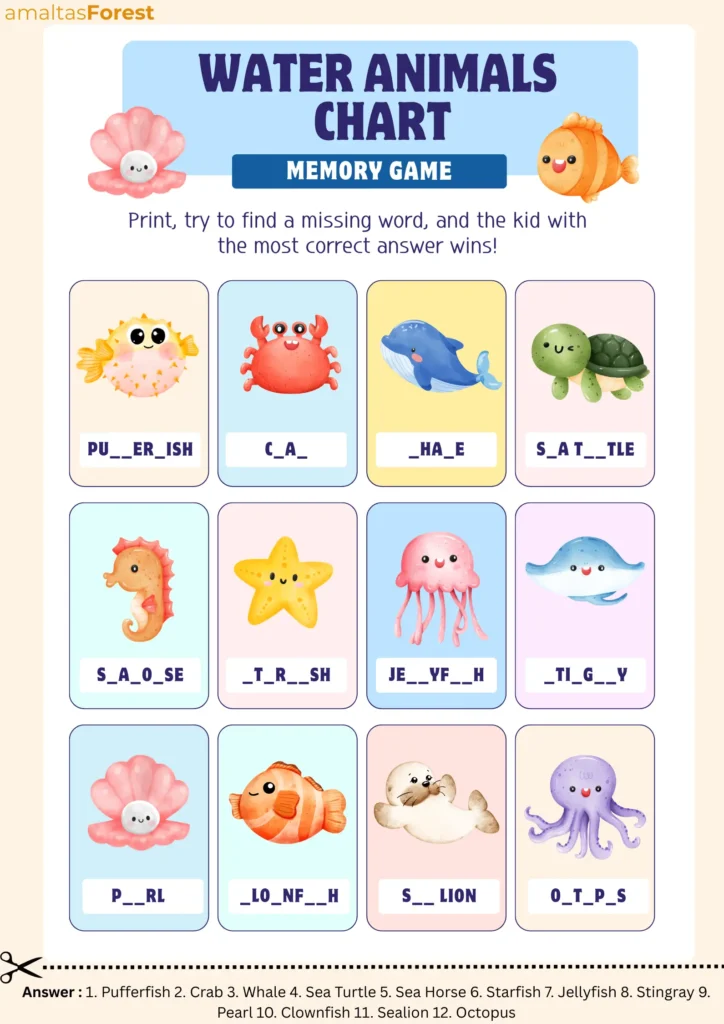
Fun activities for Kids
Kindergarten loves sea animals games with hands-on learning which help in developing motors skills, lists contain games like mix movements, crafts and simple learning activities.
Movement Games
These exciting games get kids moving like ocean animals while learning names like shark and octopus.
- Swim Like Sea Animals: Call out an animal name like “Crab” and kids walk sideways like a crab. Say “Dolphin” and they jump and dive. Play ocean music to make it extra fun.
- Ride the Waves: Place paper “surfboards” on the floor using tape. Kids stand on them and balance by leaning left and right or jumping over pretend waves.
- Feed the Shark: Make a shark mouth using a cardboard cutout. Kids toss paper fish into the mouth while practicing counting or matching colors.
Fishing Activities
These fun activities are perfect for learning sea animals while building fine motor skills.
- Magnetic Fishing: Place paper fish with paperclips on a blue mat “ocean”. Add numbers or dots on each fish. Kids use magnetic fishing rods to catch them and practice counting.
- Color Fish Sort: Set up a small “boat” area with colorful felt fish. Children hook the fish and sort them by color or size.
Craft & Literacy Fun
Connect sea animal learning with Hindi or Marathi names and fun facts for bilingual play.
- Octopus Facts: Children write or draw one fact on each tentacle and create a big classroom octopus display.
- Crab Sequencing: After reading a “Hermit Crab” story, kids arrange sea animal pictures in the correct order on shell cutouts.
- Whale Addition: A “hungry whale” uses goldfish crackers to help children solve simple addition problems by finding the missing number.
Related Blog
- Discover the List of colors name in english a to z to make kids aware of colors names.
- A Practical downloadable and printable List of 50 dry fruits name in english and hindi
- A Practical learning experience of Body parts names in english for kids with pictures and worksheets.
- See how Omnivores animals survive their food habits learn with pictures and worksheets.
- Learn more about Pet animals name in english and hindi help in improving understanding.
- Check out 100 vegetables name in english and hindi help in developing healthy eating habit at early age.
FAQ’s
1. Water animals name 10 ?
Here are 10 water animals: Shark, Dolphin, Whale, Octopus, Starfish, Seahorse, Crab, Jellyfish, Turtle and Seal.
2. 7 water animals name ?
Here are 7 water animals: Fish, Shark, Dolphin, Whale, Octopus, Crab and Seahorse.
3. Name some marine creature ?
Some marine creatures are shark, dolphin, whale, octopus, starfish and jellyfish. They live in the ocean and are specially made to survive in salty water.
4. What are water animals ?
Water animals are animals that live in water like oceans, rivers and lakes. They have special body parts like gills or fins that help them swim and breathe in water.
5. What is the biggest water animal ?
The biggest water animal is the Blue Whale. It can grow up to about 30 meters long and is the largest animal to ever live on Earth.
6. What are small water animals ?
Small water animals are tiny creatures that live in oceans, rivers, and ponds. Examples include shrimp, small fish, crabs and plankton that are little but very important for the water ecosystem.

Team Amaltas is a group of graduates dedicated to creating a fun and effective learning platform for kids through worksheets and educational resources.