Hello, little learners! Do you know what carnivorous means? Think… think… Let me help you. Carnivorous animals are animals that eat meat. They’re exciting for kids to learn about because many are fast hunters or strong predators in stories and zoos.
Carnivorous animals belong to a group called Carnivora and they eat meat. A carnivore means a meat eater, and its synonym is flesh-eater. Animals like lions and tigers live in nature and help keep the environment balanced by controlling other animal populations.
This blog helps kids become familiar with carnivorous animals by explaining their meaning, giving examples, describing their diet and classification, and providing worksheets for practice. It also includes drawing pages for coloring and charts for visual interaction with carnivorous animals.
What is a carnivore ?
A carnivore is an animal that primarily eats meat of other animals, relying on hunting or scavenging for food. Animals have sharp teeth, strong jaws and claws adapted for catching and hunting prey. Carnivorous animals play key roles in ecosystems by controlling populations of herbivores.
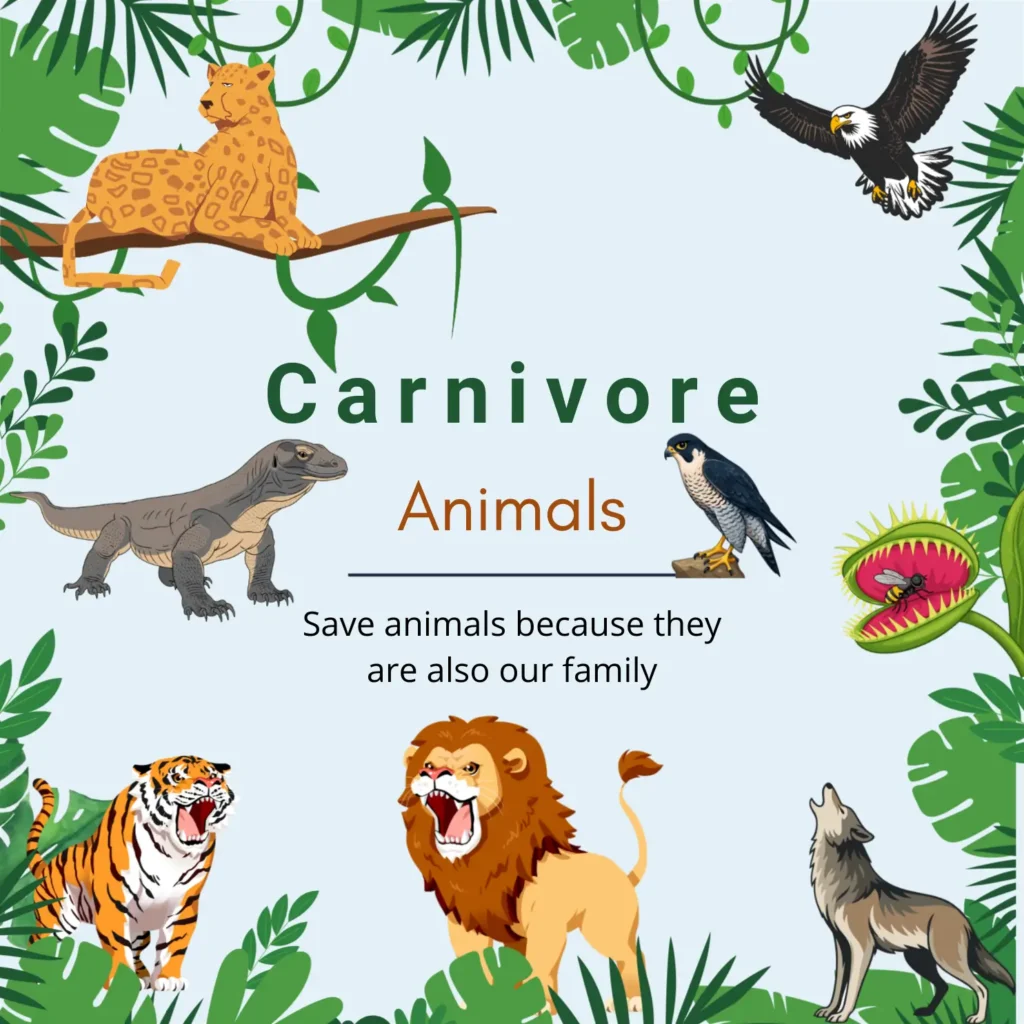
Carnivore definition : Meat eater animals get most of their energy from animal tissue, fat, bones and organs by hunting other animals like mammals, birds, fish, insects. Have a shorter digestive system suited for protein-rich diets. Example : Lion, Wolf, Tiger, Cheetah, Jaguar, Hyenas, Eagle, Falcon, Shark, Tuna.
Check out this Carnivorous Animals Colouring Worksheet featuring animals like the Lion and Tiger, great for boosting kids’ motor skills while learning.
How to Pronounce Carnivorous ?
Carnivorous is pronounced as “kar-NIV-er-uhs” in American English, with stress on the second syllable.
Phonetic Spelling : Use this guide: /kɑrˈnɪvərəs/ (the “kar” rhymes with “car” , “niv” like “give” and ends with “uh-ruhs” ). British English is similar: /kɑː
Say it slowly as car-NIV-or-us, then say it faster while stressing the “NIV” sound. You can listen to native pronunciation on Youtube (American English) and British Pronunciation. Kids learning about carnivores, such as meat-eaters like lions, can practice saying it during animal lessons.
Characteristics of Carnivorous Animals
Carnivorous animals have special features that help them catch and eat other animals, such as sharp teeth, strong jaws, good senses, body structure, occasional venom use and stomachs made to digest meat.
- Carnivorous Animals Teeth and Jaws : Have sharp pointed canines for tearing flesh, gripping prey, paired with carnassail teeth the last upper premolar and first lower molar, that shear meat like scissors. Powerful jaw muscle for quick closure and masseter for grip, enable strong bites, while restricted jaw movement focuses on slicing rather than grinding.
- Senses : Forward-facing eyes help predators judge distance, strong night vision helps them see in the dark, and a powerful sense of smell helps track prey. Sharp hearing detects faraway sounds, and whiskers help them move safely in low light.
- Body Structure : Sleek bodies and strong back legs help predators run fast or ambush prey, while claws and flexible spines improve grip and movement. Some have short legs for stalking, others long legs for chasing, and many have fur patterns that help them blend in.
- Venom Use : Most carnivores do not use venom, but a few, such as some shrews and slow lorises, have toxic saliva that enters through grooved teeth to weaken prey. This uncommon feature helps them handle larger or well-defended animals without needing much strength.
- Digestive System : Carnivores have short intestines to digest meat quickly, very acidic stomachs to break down bones and germs, and large livers to handle fats. They lack large fermentation areas because meat has little fiber.
3 Carnivores Animals
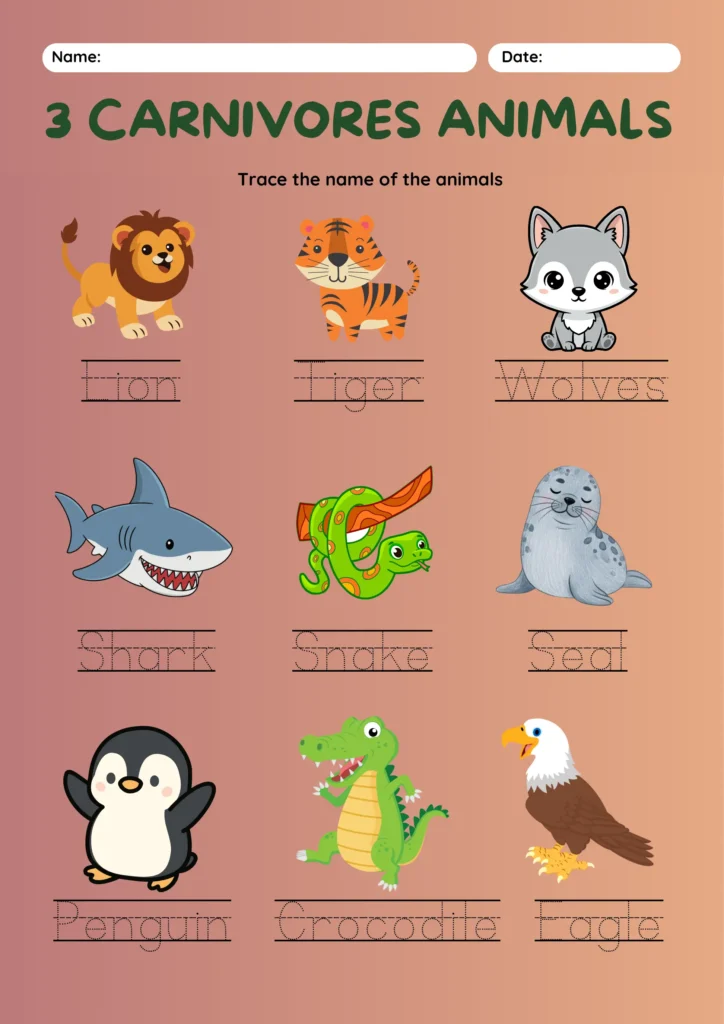
The three well known carnivores are Lions, Wolves, and Eagles.
- Lions : Lions hunt together on the African savanna and often prey on large animals like zebras.
- Wolves : Wolves hunt in packs, in forests and tundra, feeding on deer and other small mammals.
- Eagles : Eagles fly high to spot fish or rodents and catch them with their sharp talons (a long sharp curved nail).
Classification of Carnivorous Animals
Carnivorous animals are classified based on prey type, hunting method, and diet composition, reflecting their ecological roles.
Depending Upon the type of Carnivore Animals
Carnivores specialize in specific prey, adapting teeth, jaws, and senses accordingly.
- Aviovore : Aviovores are animals that eat birds. Falcons and eagles are examples, and they catch their prey by flying fast.
- Insectivores : Insectivores eat insects. Examples of insectivores include anteaters, bats, and shrews, which use long tongues or echolocation to catch their prey.
- Vermivore : Vermivores eat worms. Some, like robins and moles, specialize in hunting earthworms by probing the soil.
- Hematophage : Hematophages feed on blood. Animals like vampire bats and ticks pierce the skin to drink blood without killing their hosts right away.
- Piscivore : Piscivores eat fish. Animals like herons, kingfishers, and grizzly bears catch them by diving or spearing.
- Oviovore : Oviovores eat eggs. Animals like skunks and snakes raid nests to get these nutrient-rich meals.
On the Basis of How these Animals get their Food
Carnivores get their meat by either actively hunting or feeding on available carcasses.
- Predators : Predators hunt live animals. Lions, for example, use speed and teamwork to catch herbivores.
- Scavangers : An animal that feeds on dead animals. Vultures and hyenas, for example, find carcasses using keen senses, helping recycle nutrients and prevent the spread of disease.
On Basis of Diet Spectrum
An animal’s diet shapes its teeth and digestive system, whether it eats only meat or a mix of foods.
- Hypercarnivore / Obligate Carnivore : Hypercarnivores (Obligate Carnivores) get over 70% of their calories from meat. Animals like cats and most cat families (felids) need meat to survive.
- Mesocarnivore : Mesocarnivores get 50 – 70% of their food from meat. Animals like foxes and coyotes eat plants to make up the rest.
- Hypocarnivore : Hypocarnivores get less than 30% of their food from meat. Animals like badgers and mongooses eat a mix of foods.
Check out free and downloadable printable worksheets of Sorting Animals Worksheet : Pet and Wild Animals
Five Carnivorous Animals
Five notable carnivorous animals are :
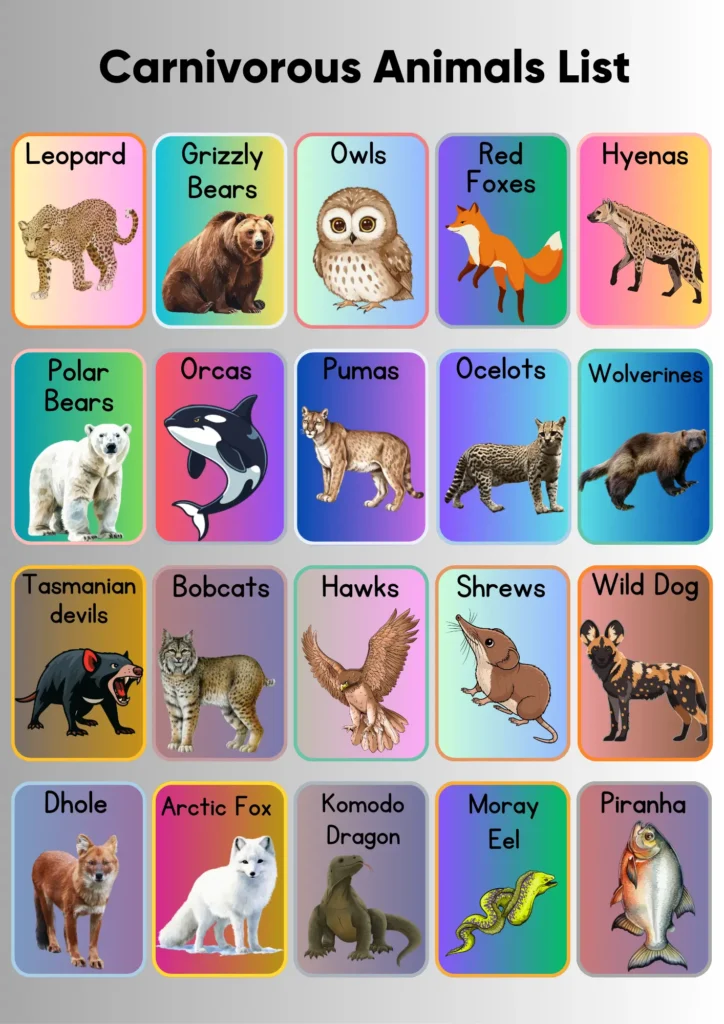
- Leopard : Leopards are solitary cats that ambush prey like antelope and monkeys from trees. Their spots help them hide, and strong jaws crush their prey.
- Cheetahs : Cheetahs can run up to 60 mph to catch gazelles on the African savanna. They use sharp eyesight and claws for grip and mainly eat medium-sized animals, but cannot climb trees.
- Grizzly Bears : Grizzly bears eat both plants and animals but rely on meat when hunting salmon, rodents, or elk. They are strong enough to flip rocks to catch insects or fish.
- Owls : Barn owls hunt rodents quietly at night using sharp hearing. They catch prey with talons and swallow small animals whole, later spitting out bones and fur as pellets.
- Red Foxes : Red foxes hunt voles (small rodents) by pouncing through snow, using sharp hearing and their bushy tail for balance. They also catch rabbits and birds and live in cities.
10 Carnivorous Animals
Below is the list of 10 carnivorous animals and their diet :
| Animal Name | Diet |
| Hyenas | Eat zebras, antelopes, wildebeest, rodents and carrion |
| Polar bears | Eat seals, fish, birds eggs and occasionally birds |
| Orcas (killer whales) | Eat fish, seals, penguins, squid, sea turtle and other whales |
| Pumas (mountain lions) | Eat deer, rabbits, rodents and small mammals |
| Ocelots | Eat rodents, birds, rabbits and reptiles |
| Wolverines | Eat small mammals, carrion, frog and birds |
| Tasmanian devils | Eat insects, birds, mammals, reptiles and carrion |
| Bobcats | Eat rabbits, birds, squirrel and rodents |
| Hawks | Eat rodents, birds, frog, lizard and insects |
| Shrews | Eat insects, worms, spiders and small invertebrates |
About Carnivorous Plants
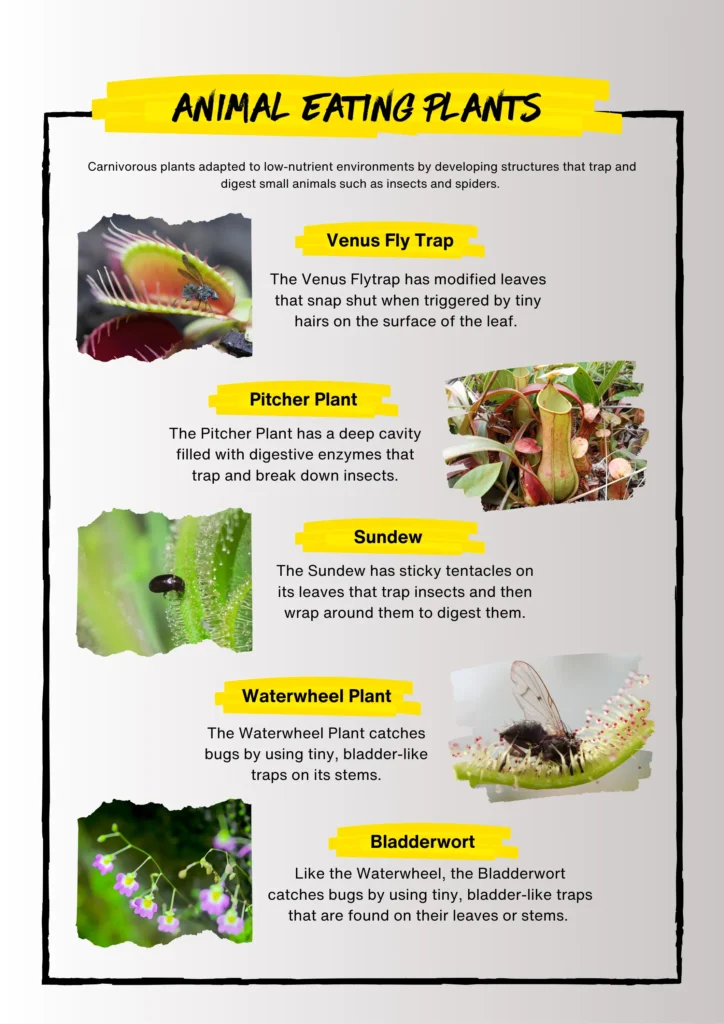
Carnivorous plants are specially adapted plants that trap and digest small animals, mainly insects, to gain essential nutrients like nitrogen that are lacking in the nutrient-poor soils of habitats such as bogs and wetlands.
Key Characteristics
- Attract prey using bright colors, scents, or nectar
- Capture prey with snap traps, sticky surfaces, pitfall pitchers, or suction bladders
- Kill prey by drowning, suffocation, or digestive enzymes
- Digest prey externally using enzymes and acids
- Absorb nutrients through specialized glands to support growth
Types of Carnivorous Plants
- Venus Flytrap (Dionaea muscipula): The Venus flytrap uses snap traps that close very quickly when tiny hairs are touched, trapping and digesting flies in about a tenth of a second.
- Pitcher plants (Nepenthes, Sarracenia): Pitcher plants have deep, tube-shaped traps filled with liquid and insects fall in, drown, and are digested.
- Sundews (Drosera): Sundews use sticky, hair-like tentacles to trap insects, then slowly bend around them to digest them.
- Bladderworts (Utricularia): Bladderworts are water plants that use tiny suction traps to quickly suck in and trap very small organisms.
- Waterwheel Plant (Aldrovanda vesiculosa): An aquatic waterwheel plant recognized for its lightning-fast underwater snap traps that capture tiny prey such as water fleas and copepods.
Role in Ecology : They live in sunny, acidic places with poor soil around the world (except Antarctica). Even though catching prey takes energy, the nutrients they get from it help them survive and grow better in these tough environments.
Carnivorous Animals Name
Below is the list of carnivorous animals (animals that eat meat only) with their diet :
| Animals Name | Diet |
| Jaguar | Deer, capybaras, fish, reptiles, birds, monkeys |
| African Wild Dog | Antelope, gazelles, small mammals, impala, kudu |
| Dhole (Asiatic wild dog) | Deer, wild pigs, rodents, sambar, wild boar, birds |
| Arctic Fox | Lemmings, birds, fish, eggs, insects |
| Fennec Fox | Insects (grasshoppers, locusts), small rodents, lizards |
| Bat-eared Fox | Termites, dung beetles, insects, lizard, scorpions, small rodents |
| Komodo Dragon | Deer, pigs, carrion, wild boar, water buffalo, birds, eggs |
| American Alligator | Fish, turtles, birds, mammals, snake, birds |
| Caiman | Fish, crustaceans, small animals, reptiles, amphibians |
| Stoat (Ermine) | Rabbits, mice, birds, vole, eggs, insects |
| Least Weasel | Mice, voles, small birds, lemmings, young rabbits |
| Mink | Fish, frogs, small mammals, fish, ducks, crayfish |
| Pine Marten | Squirrels, birds, eggs, vole, beetle, wasps, carrion |
| Black-footed Ferret | Prairie dogs, mice, ground squirrel |
| Eurasian Lynx | Hares, birds, deer, rodents, birds, chamois |
| Caracal | Birds, rodents, small antelope, small mammals, hyraxes |
| Serval | Rats, birds, frogs, fish, flamingos, insects, reptiles |
| Common Vampire Bat | Blood of mammals (Like livestock, horses) |
| Moray Eel | Fish, octopus, crustaceans, crab, shrimp |
| Barracuda | Fish |
| Piranha | Fish, insects, small animals, worms, carrion |
| Giant Squid | Fish, other squid |
| Common Octopus | Crabs, mollusks, fish, lobsters, shrimp, snails |
| Mantis Shrimp | Crabs, snails, fish, clams |
| Praying Mantis | Insects, small reptiles, frog, spiders, moth, cricket |
| Wolf Spider | Insects (spiders), ants, beetles and other spiders |
| Tarantula | Insects, small frogs, mice, lizards, cricket |
| Scorpion | Insects, spiders, cricket, grasshoppers, beetles, cockroaches |
| Giant Centipede | Insects, lizards, mice, fox, snakes, bats, frog |
| Dragonfly | Mosquitoes, flies, small insects, moth |
Facts About Carnivorous Animals
Here are some interesting and kid-friendly facts about carnivorous animals :
What Are Carnivores?
- Carnivores are animals that eat mostly or only meat.
- The word carnivore comes from Latin and means “meat eater.”
Teeth & Bodies
- Carnivores usually have sharp teeth for tearing meat.
- Many have strong jaws and claws to help catch prey.
- Their digestive systems are often shorter, which helps process meat faster.
Types of Carnivores
- Obligate carnivores (like cats) must eat meat to survive.
- Facultative carnivores can eat some plants but prefer meat.
- Scavengers (like vultures) eat animals that are already dead.
Examples of Carnivorous Animals
- Land: Lions, wolves, tigers, cheetahs
- Water: Sharks, dolphins, orcas
- Air: Eagles, hawks, owls
- Reptiles: Crocodiles, snakes
Hunting & Behavior
- Some carnivores hunt alone (like tigers).
- Others hunt in groups (like wolves).
- Many have excellent senses, such as sharp eyesight or strong smell.
Cool Facts
- A cheetah is the fastest land animal.
- Owls can rotate their heads very far to spot prey.
- Sharks have multiple rows of teeth and can regrow them.
Herbivore, Carnivore, Omnivore Game
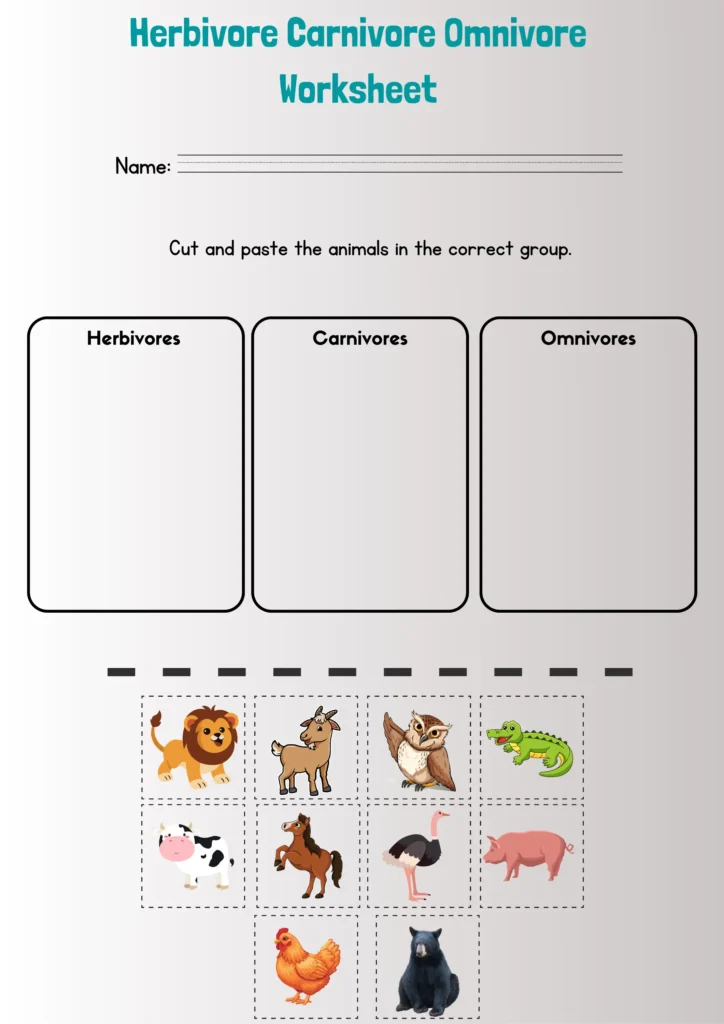
Herbivore, carnivore, and omnivore games help children learn animal diets through fun quizzes and sorting activities.
- Pick the Animal : Animals are placed around the room or yard. The teacher calls out a food type such as “plants,” “meat,” or “both.” Students walk around, find an animal that matches the food type, and stand next to it. A quick check is done, then the next round begins.
- Food Clue Hunt : Picture cards of animals are hidden in different areas. The teacher gives a clue like “This animal eats only plants.” Students search, pick one animal card they think fits, and return. Correct answers earn a point or a thumbs-up.
- Mystery Animal Walk : Students move around the space while music plays. When the music stops, the teacher reads a short description such as “I eat plants and meat.” Students quickly point to or hold up an animal that matches.
- Scavenger Match : Students receive a simple checklist with one herbivore, one carnivore, and one omnivore to find. They walk around, locate animals that fit each category, and check them off.
For video learning to know more about carnivores animals Kid Tv Carnivorous Animals | Carnivores Animals Name in English.
FAQ’s
1. Are humans carnivores ?
No humans are not carnivores, humans biologically classified as omnivores body designed for eating both plants and animals.
2. What do carnivores eat ?
Carnivores are meat eaters, with a short digestive system and enhanced senses for hunting.
3. Cat is carnivore or omnivore ?
Cats are obligate carnivores, get 70% of energy by consuming meat rest from milk and other sources.
4. Frog is carnivore or omnivore ?
Frogs are primarily carnivores, at adult stage consume insects, flies, moths, ants and beetles. The Tadpole stage consumes algae and small plants.
5. What are 5 animals that only eat meat ?
5 animals are Lion, Tiger, Wolves, Crocodile, Eagle
6. Is a bird a carnivore ?
Yes bird like Eagle, Falcon, Hawk and Owl are carnivores

Team Amaltas is a group of graduates dedicated to creating a fun and effective learning platform for kids through worksheets and educational resources.